I've been looking back through my blogs and I think the biggest discovery for me was SIRS Discoverer. I am looking forward to getting more time to work it into classroom activities. I found it a helpful resource for lecture notes.
I have put together a 3-ring binder with all of the handouts that were offered. We do enrichment for students on Monday mornings and have inservice most Monday afternoons. I am hoping that one of these Mondays, I will be able to present this information to some of my coworkers. I have been talking it up quite a bit and shooting e-mails here and there to teachers that come to mind as I find certain pieces of information.
I have learned a lot. It's almost mind boggling, but I know that the only way that I will retain most of it will be to use it as frequently as possible. Thanks for a really useful study.
Friday, March 23, 2012

Lesson 9 - My Personal Favorite
Ok - let me start by saying that I LOVE genealogy study. I really got into it about 8 years ago and spent quite a bit of time collecting information. I have met people from all over the country that are either related or just big dorks like me who don't mind helping out on my search. Genealogists are generally very generous with their resources and search techniques!
I did a search of my maiden name and found my birth record. I didn't see my marriage license, but I'm not sure if SD publishes any records on living citizens. I also found myself in some of the telephone listings as was mentioned in the blog directions. (I have a subscription to Ancestry so I know that I am on there more than can be viewed publicly.)
I searched for my husband's grandparents and had great luck! Fern Mae Hill shows up on several censuses. I happened to have a student near my desk and we did a quick search for his great grandmother and found results. It was really neat to be able share that with him.
When I did my photo search using South Dakota as my keyword, I found some interesting pictures of former professional baseball players. I also found an image that tied directly to the 8th grade social studies class that I subbed for today. It was an old advertisement for cheap or free land in South Dakota as of 1890.
For me, HeritageQuest is less user-friendly than Ancestry. I was still able to find a few resources that might be useful, but one of the features I love about commercial Ancestry is the family trees that are submitted by family researchers. I find that to be an incredibly valuable tool - though they should be used with a critical eye.
I used Sanborn Maps to look at Sioux Falls. The oldest map was from December of 1883. The Queen Bee Mill is on the 1883 map and though it's no longer in use, the footprint is still there by the Falls. It's pretty interesting to see how the city changes over just a few years' time.
I did a search of my maiden name and found my birth record. I didn't see my marriage license, but I'm not sure if SD publishes any records on living citizens. I also found myself in some of the telephone listings as was mentioned in the blog directions. (I have a subscription to Ancestry so I know that I am on there more than can be viewed publicly.)
I searched for my husband's grandparents and had great luck! Fern Mae Hill shows up on several censuses. I happened to have a student near my desk and we did a quick search for his great grandmother and found results. It was really neat to be able share that with him.
When I did my photo search using South Dakota as my keyword, I found some interesting pictures of former professional baseball players. I also found an image that tied directly to the 8th grade social studies class that I subbed for today. It was an old advertisement for cheap or free land in South Dakota as of 1890.
For me, HeritageQuest is less user-friendly than Ancestry. I was still able to find a few resources that might be useful, but one of the features I love about commercial Ancestry is the family trees that are submitted by family researchers. I find that to be an incredibly valuable tool - though they should be used with a critical eye.
I used Sanborn Maps to look at Sioux Falls. The oldest map was from December of 1883. The Queen Bee Mill is on the 1883 map and though it's no longer in use, the footprint is still there by the Falls. It's pretty interesting to see how the city changes over just a few years' time.
Thursday, March 22, 2012
Lesson 8- ArchiveGrid and CAMIO
I did the suggested "Sitting Bull autograph card" and learned some interesting things about Sitting Bull. I had no idea that he was a shaman. I always mentally associate Sitting Bull with Little Big Horn, but didn't really know how everything came to an end. I didn't realize that he traveled with Buffalo Bill after being captured. It was surprising to me that the government allowed Sitting Bull to travel. I would have thought they might consider him a huge threat to national security.
I tried a number of searches using the ArchiveGrid. I may not have had the patience that was warranted to find the best results or I just may have been looking for obscure items. I love doing genealogy research (yea lesson 9!) and thought I'd try looking for some resources that I know exist, but am not sure are in any formal collection. I have received copies and translations from other genealogy buffs, but have never directly requested information from a library. I was looking from some German reference materials called orsippenbuch, but didn't find much of anything.
CAMIO
I knew Paul Revere was a silversmith, but it's really an amazing thing to be able to look at images of his work. His craftsmanship is something else. I also found it interesting that there was a Paul Revere, Jr. who excelled in art, but in a different way than his father.
The search term "Sioux" brought up some great Native American artifacts. I could see this being used in social studies, art, humanities, etc. Again, the craftsmanship is something to behold. I find one of the most interesting details is that the materials are included. I looked a pouch that listed mallard duck scalp as one of the materials. Really ingenious!
I don't really have a favorite artist, but I did a search for quilts. I LOVE quilts, but I am not patient or talented enough to produce one. The first result was a beautiful friendship quilt from about 1840. The woman who started the quilt thought that in this nation so focused on business, it would be a great way for extended families and friends to spend time together. Funny what hasn't changed!
I would personally use CAMIO as a way to tie fine arts into other content areas - especially social studies and literature. I could see using an image as a writing prompt and then learning more about the actual inspiration behind it.
I really like the idea of being able to personalize the CAMIO search. I could definitely see its use if one were studying art and wanted to compare an artist's works through different time periods or compare/contrast different artists. It could also be used in the social studies realm if one looked at art from different cultures that dealt with a single event. I could also see a use in composition if one was looking at the concepts of comparison versus contrast and using different images to reinforce the concepts.
I tried a number of searches using the ArchiveGrid. I may not have had the patience that was warranted to find the best results or I just may have been looking for obscure items. I love doing genealogy research (yea lesson 9!) and thought I'd try looking for some resources that I know exist, but am not sure are in any formal collection. I have received copies and translations from other genealogy buffs, but have never directly requested information from a library. I was looking from some German reference materials called orsippenbuch, but didn't find much of anything.
CAMIO
I knew Paul Revere was a silversmith, but it's really an amazing thing to be able to look at images of his work. His craftsmanship is something else. I also found it interesting that there was a Paul Revere, Jr. who excelled in art, but in a different way than his father.
The search term "Sioux" brought up some great Native American artifacts. I could see this being used in social studies, art, humanities, etc. Again, the craftsmanship is something to behold. I find one of the most interesting details is that the materials are included. I looked a pouch that listed mallard duck scalp as one of the materials. Really ingenious!
I don't really have a favorite artist, but I did a search for quilts. I LOVE quilts, but I am not patient or talented enough to produce one. The first result was a beautiful friendship quilt from about 1840. The woman who started the quilt thought that in this nation so focused on business, it would be a great way for extended families and friends to spend time together. Funny what hasn't changed!
I would personally use CAMIO as a way to tie fine arts into other content areas - especially social studies and literature. I could see using an image as a writing prompt and then learning more about the actual inspiration behind it.
I really like the idea of being able to personalize the CAMIO search. I could definitely see its use if one were studying art and wanted to compare an artist's works through different time periods or compare/contrast different artists. It could also be used in the social studies realm if one looked at art from different cultures that dealt with a single event. I could also see a use in composition if one was looking at the concepts of comparison versus contrast and using different images to reinforce the concepts.
Wednesday, March 21, 2012
Lesson 7 - Finally!
Finally getting back into the swing of things after a few ridiculously busy weeks! New granddaughter, Nora, has finally made her appearance so all is well with the world.
I chose to look for the phrase "mockingbird", but came up with way too many options. I then added "kill a mockingbird" and came up with 4 search results. The first result said that there To Kill A Mockingbird was found in 21 libraries. Hmmm, I'm not sure what that means. The first library that pops up is the Highland County Public Library System. Call number is 813. When I click on Harper Lee, I come up with 1201 resources of many types. I didn't see a subject option on this resource.
Using the OAIster database, I looked at a letter written by Norman Noble to the Bryant College Service Club. I like the idea of being able to pull up a digital copy of the original letter as well as a typed copy of the letter.
I looked at Hopeless' blog. I agree that there is A LOT of information available. I could see myself using WorldCat now and then. We just had our book fair. There are a few ISBN's that are not recognized by Surpass Copycat and WorldCat would be helpful for getting the MARC record set up correctly.
I chose to look for the phrase "mockingbird", but came up with way too many options. I then added "kill a mockingbird" and came up with 4 search results. The first result said that there To Kill A Mockingbird was found in 21 libraries. Hmmm, I'm not sure what that means. The first library that pops up is the Highland County Public Library System. Call number is 813. When I click on Harper Lee, I come up with 1201 resources of many types. I didn't see a subject option on this resource.
Using the OAIster database, I looked at a letter written by Norman Noble to the Bryant College Service Club. I like the idea of being able to pull up a digital copy of the original letter as well as a typed copy of the letter.
I looked at Hopeless' blog. I agree that there is A LOT of information available. I could see myself using WorldCat now and then. We just had our book fair. There are a few ISBN's that are not recognized by Surpass Copycat and WorldCat would be helpful for getting the MARC record set up correctly.
Friday, February 17, 2012
Lesson 6 continued
Thank you for the quick response to my plea for help!
I was able to complete the assignment successfully. I looked at both NE and OK and found that most of the history sources listed were published by the University of Nebraska and the University of Oklahoma respectively. One title that caught my eye in the Oklahoma search was The Rapid City Indian School. This is a book I would not normally be drawn to for traditional library check out. However, I think that even giving users the chance to browse more titles opens up other possibilities for expanded research or even leisure non-fiction reading.
I was able to complete the assignment successfully. I looked at both NE and OK and found that most of the history sources listed were published by the University of Nebraska and the University of Oklahoma respectively. One title that caught my eye in the Oklahoma search was The Rapid City Indian School. This is a book I would not normally be drawn to for traditional library check out. However, I think that even giving users the chance to browse more titles opens up other possibilities for expanded research or even leisure non-fiction reading.
Lesson 6 - eBooks on EBSCOhost
It's been awhile, but I'm back to the blog.
I chose anatomy as my search term. I came up with a number of resources including many that would likely be texts for college classes. I don't know how often my students would use these resources, but if they needed books for a research paper, this would be a much better avenue than looking at our small nonfiction selection.
For the constitution day question, I'd probably recommend The Complete Idiot's Guide to the American Presidents. It wouldn't be too technical, but it would give my students enough information to get started.
I am having trouble completing #3 on this lesson. I am not sure where to put the PB. I see it under field codes, but there is nowhere to select it. Any ideas what I'm doing incorrectly?
I chose anatomy as my search term. I came up with a number of resources including many that would likely be texts for college classes. I don't know how often my students would use these resources, but if they needed books for a research paper, this would be a much better avenue than looking at our small nonfiction selection.
For the constitution day question, I'd probably recommend The Complete Idiot's Guide to the American Presidents. It wouldn't be too technical, but it would give my students enough information to get started.
I am having trouble completing #3 on this lesson. I am not sure where to put the PB. I see it under field codes, but there is nowhere to select it. Any ideas what I'm doing incorrectly?
Tuesday, February 7, 2012
Lesson 5 Gale Virtual Reference Library
I looked at the Gale Encylopedia of Science, Volume 2. We are studying DNA replication in Biology, so I thought I'd take a look. For my particular sophomore class, the reading level may be a bit too high. However, a more advanced student or perhaps a teacher would find the article a useful supplement or clarification.
I did like that the option was there for a user to listen to the article, to download as an MP3 or download to an eReader. I think users today would appreciate the options. Students in our school are not patient enough to sit down in the library to do research unless it is required of them. They want information to go and this fits the bill.
I just had a student come in who is looking for classic literature for his College English class. The caveat is that it cannot be a book that has been referenced in his college course or one that was used during HS English. I searched for great novels and came up with several options. There were a number of titles that grouped literature based on a theme - literature of war, race and prejudice, the American Dream, etc.
I used the plot overview limitation and found quite a list: The Red Badge of Courage, Catch-22, Lonesome Dove, The Last of the Mohicans, etc.
I found another blogger who looked at the College Blue Book. We have a daughter entering college in the fall, and though she knows where she's headed, I agree that The College Blue Book might be a good starting point for others.
I did like that the option was there for a user to listen to the article, to download as an MP3 or download to an eReader. I think users today would appreciate the options. Students in our school are not patient enough to sit down in the library to do research unless it is required of them. They want information to go and this fits the bill.
I just had a student come in who is looking for classic literature for his College English class. The caveat is that it cannot be a book that has been referenced in his college course or one that was used during HS English. I searched for great novels and came up with several options. There were a number of titles that grouped literature based on a theme - literature of war, race and prejudice, the American Dream, etc.
I used the plot overview limitation and found quite a list: The Red Badge of Courage, Catch-22, Lonesome Dove, The Last of the Mohicans, etc.
I found another blogger who looked at the College Blue Book. We have a daughter entering college in the fall, and though she knows where she's headed, I agree that The College Blue Book might be a good starting point for others.
Friday, February 3, 2012
Lesson 4 Proquest
I feel like I've been learning a lot so far! I am excited for this new exercise.
I thought that I would do a search on the Hunger Games. I have students ask for it almost everyday and our waiting list is extensive. On my initial search request, I found articles from scholarly journals, trade journals, magazines, and newspapers. The scholarly journals were what I expected - literary reviews. The Horn Book Review was often cited as a trade journal.
I posted to Electronic Resources Edition: Part 2, but when I hit publish, a drop down asked for profile. I chose Google account and all my typing was gone. Ugh! My main comments were that my inner nerd was also thrilled to see access to all sorts of publications.
When I clicked on the Publications tab, there were over 3800 publications! Yowza! I tried to type in science as my search request, but found that I needed to be more specific as it pulled any title with science in it, including political science and computer science. When I narrowed it down to Biology, I found the search to be more manageable. I clicked on The American Biology Teacher. I even e-mailed myself one of the articles from the latest issue about using postage stamps to teach science. I just did a postage stamp project and one of my students claimed it was a little archaic considering the decline of snail mail. I'll be forwarding him that article ;)
I thought that I would do a search on the Hunger Games. I have students ask for it almost everyday and our waiting list is extensive. On my initial search request, I found articles from scholarly journals, trade journals, magazines, and newspapers. The scholarly journals were what I expected - literary reviews. The Horn Book Review was often cited as a trade journal.
I posted to Electronic Resources Edition: Part 2, but when I hit publish, a drop down asked for profile. I chose Google account and all my typing was gone. Ugh! My main comments were that my inner nerd was also thrilled to see access to all sorts of publications.
When I clicked on the Publications tab, there were over 3800 publications! Yowza! I tried to type in science as my search request, but found that I needed to be more specific as it pulled any title with science in it, including political science and computer science. When I narrowed it down to Biology, I found the search to be more manageable. I clicked on The American Biology Teacher. I even e-mailed myself one of the articles from the latest issue about using postage stamps to teach science. I just did a postage stamp project and one of my students claimed it was a little archaic considering the decline of snail mail. I'll be forwarding him that article ;)
Lesson 3 Sirs - Finally
Ok- I hope that I'm not the only one this far behind. I am hoping to get back on track this weekend!
I am sad to say that I have never used SIRS before. There are sooooo many options out there, I don't know if I'll ever get to sample even 1% of them, but on first look, this is one that I would use again.
I did the recommended SIRS Discoverer search for armadillos. I came up with 78 sources. I can really appreciate the reading level indicators as well as those with graphics. I think this resource would work well for beginners as well as seasoned researchers.
I clicked on one of the links that indicated an easy article from Ranger Rick. I liked the fact that not only was the article included with links to the graphics, but there was also a link to both a thesaurus and dictionary. What a great way to give students the ability to be more autonomous!
For the second part of the Discoverer section, I chose to look at Greece in the database features. The link brought up the facts, of course, but it also provided graphic organizers for teaching resources, graphics including a map and the Greek flag, and MLA documentation that could be cut and pasted to a student's research.
I looked at several maps in the Maps of the World section. My husband teaches American History and I could see this being an excellent supplement for his students. He would not need to hope for the best in a random internet search, but could specify exactly what he wanted to depict in a map of the Civil War, for instance.
I looked at the Educator Resources and Activities. In addition to library duties, I also teach sections of Biology and Anatomy. I thought some of the graphic organizers about how to analyze charts and graphs would be a great tool for the beginning the year. I looked at a couple of the links under activities (I'm definitely going back to this!!). I found some activities that were question/answer and a really neat activity that I'm going to try later with my 4 year old to use science to make dull pennies bright and shiny again.
In the SIRS Issues Researcher, I was, of course, drawn to the topic of banning books. The topic overview let me know that the issue was bigger than just books, it was all about censorship. When I clicked on a link to one of the essential questions, I was able to see many article both for and against the issue. I think our high school social studies teacher uses this. If not, I'll be pestering him to give it a look on our next school day.
Why, oh why, didn't I make time for this before??? The curriculum pathfinders has tons of information! So much better than a google search. I looked at the science topics and was pleased to find lots of possibilities for topics we are working on right now - heart health and genetics!
I am sad to say that I have never used SIRS before. There are sooooo many options out there, I don't know if I'll ever get to sample even 1% of them, but on first look, this is one that I would use again.
I did the recommended SIRS Discoverer search for armadillos. I came up with 78 sources. I can really appreciate the reading level indicators as well as those with graphics. I think this resource would work well for beginners as well as seasoned researchers.
I clicked on one of the links that indicated an easy article from Ranger Rick. I liked the fact that not only was the article included with links to the graphics, but there was also a link to both a thesaurus and dictionary. What a great way to give students the ability to be more autonomous!
For the second part of the Discoverer section, I chose to look at Greece in the database features. The link brought up the facts, of course, but it also provided graphic organizers for teaching resources, graphics including a map and the Greek flag, and MLA documentation that could be cut and pasted to a student's research.
I looked at several maps in the Maps of the World section. My husband teaches American History and I could see this being an excellent supplement for his students. He would not need to hope for the best in a random internet search, but could specify exactly what he wanted to depict in a map of the Civil War, for instance.
I looked at the Educator Resources and Activities. In addition to library duties, I also teach sections of Biology and Anatomy. I thought some of the graphic organizers about how to analyze charts and graphs would be a great tool for the beginning the year. I looked at a couple of the links under activities (I'm definitely going back to this!!). I found some activities that were question/answer and a really neat activity that I'm going to try later with my 4 year old to use science to make dull pennies bright and shiny again.
In the SIRS Issues Researcher, I was, of course, drawn to the topic of banning books. The topic overview let me know that the issue was bigger than just books, it was all about censorship. When I clicked on a link to one of the essential questions, I was able to see many article both for and against the issue. I think our high school social studies teacher uses this. If not, I'll be pestering him to give it a look on our next school day.
Why, oh why, didn't I make time for this before??? The curriculum pathfinders has tons of information! So much better than a google search. I looked at the science topics and was pleased to find lots of possibilities for topics we are working on right now - heart health and genetics!
Thursday, January 26, 2012
Lesson 2 - Learning Express
I tried the 4th grade math help. The diagnostic would be very helpful to a classroom teacher who was trying to get a handle on what kids are struggling with. The view answers would provide great, immediate feedback to the student. Not only does it provide the correct answer, but provides the reasoning behind the answer.
Under job search, resume and interviewing, I looked at success on the job. I chose to look at the third option, The Complete Professional. This course loaded a 192-page ebook titled, The Complete Professionial. I found information in Chapter 1 that I could use regarding organization. I don't know that I'd have time to look at this during employment, but if I was looking for a job and looking to keep a new job or set myself on the right track, this would be a great help. Plus, I wouldn't have journals or books laying on my desk that I meant to get to. I could logon when I had time and come back to it as possible.
I did a term search for literacy. I found 11 sources, 5 tests and 6 ebooks. I looked at the e-book for Read Better, Remember More. I think more advanced students or teacher-in-training would find this kind of thing useful. Most teens would not take the time to read the entire e-book, but could search the table of contents or index for the necessary topics.
Under job search, resume and interviewing, I looked at success on the job. I chose to look at the third option, The Complete Professional. This course loaded a 192-page ebook titled, The Complete Professionial. I found information in Chapter 1 that I could use regarding organization. I don't know that I'd have time to look at this during employment, but if I was looking for a job and looking to keep a new job or set myself on the right track, this would be a great help. Plus, I wouldn't have journals or books laying on my desk that I meant to get to. I could logon when I had time and come back to it as possible.
I did a term search for literacy. I found 11 sources, 5 tests and 6 ebooks. I looked at the e-book for Read Better, Remember More. I think more advanced students or teacher-in-training would find this kind of thing useful. Most teens would not take the time to read the entire e-book, but could search the table of contents or index for the necessary topics.
Thursday, January 12, 2012
Lesson 1c
I looked at the American Elk in the Spanish version. I could see this type of thing being used in our Spanish classes when looking at classification, building descriptions, etc. For students who already speak Spanish, this would be a great way to integrate what they know into the classroom.
Again, I could see the read aloud feature being used in the Spanish classroom for students who need work with fluency or pronunciation. Spanish-speaking students who face challenges in reading would also find the read aloud feature helpful for comprehension.
Again, I could see the read aloud feature being used in the Spanish classroom for students who need work with fluency or pronunciation. Spanish-speaking students who face challenges in reading would also find the read aloud feature helpful for comprehension.
Wednesday, January 11, 2012
Lesson 1b
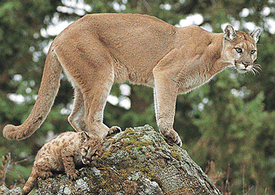
I chose the panther for the 2nd part of the lesson. The World Book Online for kids let me know that panthers are also called mountain lions, pumas, catamounts, or cougars. The writing is written at a level that elementary students can understand with links for additional photos and articles. The links on the left also suggested lesson ideas for students to teach what they learned or make a model of it.
The info finder gave many additional links to the generic search for panther. The links were more specific than what I found on World Book Online. Info finder would be, in my opinion, a better resource for a student with the ability to discern what information would be relevant and what would not. Elementary students would likely need assistance deciding which links to follow.
The World Book Online reference center has links to maps, ebooks, history, presidential papers, Danish royalty, etc. I think that teachers and more advanced students could use the reference center for all types of needs. I could see myself pulling it up during biology class to quickly find a diagram that might better convey what I'm trying to explain. Students could use it for just about any class.
Tuesday, January 10, 2012
Lesson 1a
I chose the sugar glider as my mammal to research. The World Book
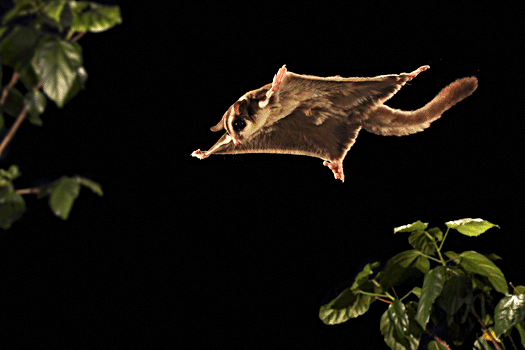 Kids Edition used a pretty large font and simplified language to describe the
habitat. World Book Student Edition had similar information, but the
writing was more advanced. It also included more about how to cite
the source and the scientific classification.
Using World Book Advance, I chose to look up Argentina. I was surprised to see just how many options were available to expand my research. I could really see HS students using this option for a variety of research needs. I especially liked that they included things like the sound of the national anthem and a walk back in time. When I clicked on one of the links, I noticed the Lexile level, options to print, email or save the source for future research, and even standard correlations. I would use that!!
The World Book Discover would be helpful to ESL students because it is available in a French or Spanish version or could be translated to a variety of other languages.
The World Book Discover would be helpful to ESL students because it is available in a French or Spanish version or could be translated to a variety of other languages.
Subscribe to:
Posts (Atom)